A full-stack quantum operating system.
Five layers, one coherent stack — from 10 mK cryogenics to ergonomic Python. Designed so research teams ship results instead of babysitting hardware.
Five layers, designed to compose — and to be replaced as the science advances.
Each layer is independently versioned. Swap simulators for hardware, or our compiler for yours, without rewriting your application.
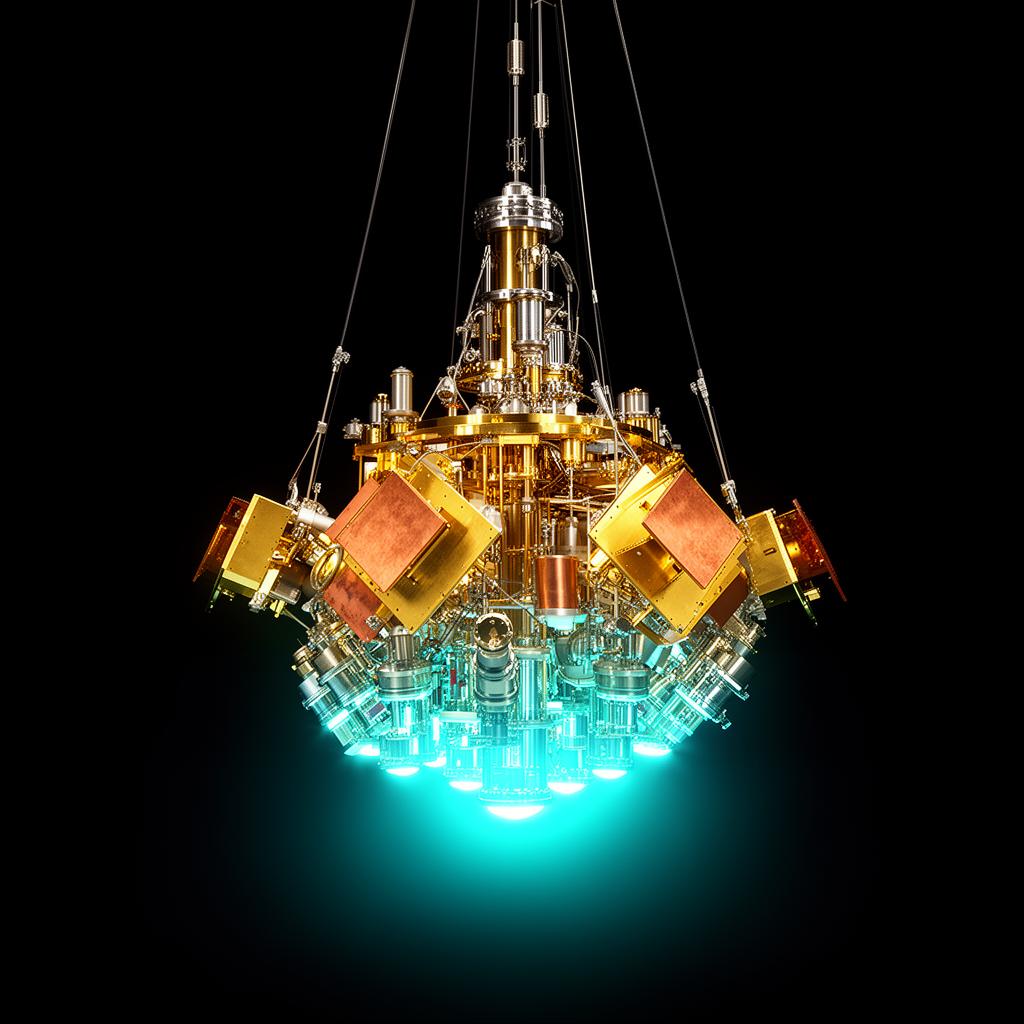
WC-890.
The production WC-890 is a 4,096-qubit transmon lattice tuned to ~5 GHz, with tunable couplers and per-qubit dispersive readout. Compiler-side, the heavy-hex topology is exposed as a virtual all-to-all graph via SWAP-aware routing and parallel teleportation.
Hello, Wave.
A single source compiles to live hardware, hosted simulators, or classical fallbacks.
from wave import circuit, run, backends

# Build a 4-qubit GHZ state
q = circuit(qubits=4)
q.h(0).cx(0, 1).cx(1, 2).cx(2, 3)

# Run on WC-890 with real-time ZNE error mitigation
result = run(
    q,
    shots=4096,
    backend=backends.wc890(region="us-west"),
    mitigation="zne+pec",
    priority="reserved",
)

print(result.histogram())
# {'0000': 0.491, '1111': 0.488, ...}
Python
sdkReference language. Pip-installable, JAX & PyTorch interop.
Rust
sdkFirst-class. Used for low-latency hybrid control loops.
Julia
sdkCommunity-maintained bindings via WaveQuantum.jl.
C / OpenQASM 3
sdkFFI for legacy compiler stacks and HPC integrations.
What we're shipping next.
Dated. Public. Updated quarterly with hits and misses.
WC-890.1 firmware
Adaptive readout 2.0, 3× faster mid-circuit measurement.
ShippingWC-1200 preview
12,288 qubits, distance-11 logical, limited partner access.
On trackWave OS 3.0
Real-time decoder integration, magic-state factories.
On trackFault-tolerant beta
100 logical qubits at 10⁻⁹ logical error per gate.
Stretch